Sociology in the Real World Chapter 2 Review Answers
x.2 The Meaning of Race and Ethnicity
Learning Objectives
- Critique the biological concept of race.
- Hash out why race is a social construction.
- Discuss the advantages and disadvantages of a sense of ethnic identity.
To understand this trouble further, nosotros need to take a critical look at the very meaning of race and ethnicity in today's society. These concepts may seem easy to define initially only are much more than complex than their definitions suggest.
Race
Allow's kickoff first with race, which refers to a category of people who share certain inherited concrete characteristics, such as peel colour, facial features, and stature. A key question about race is whether it is more than of a biological category or a social category. Nearly people think of race in biological terms, and for more than 300 years, or ever since white Europeans began colonizing populations of color elsewhere in the world, race has indeed served as the "premier source of man identity" (Smedley, 1998, p. 690).
It is certainly easy to see that people in the Usa and around the world differ physically in some obvious ways. The most noticeable difference is skin tone: some groups of people have very nighttime skin, while others have very light skin. Other differences too exist. Some people have very curly pilus, while others have very straight hair. Some have thin lips, while others have thick lips. Some groups of people tend to be relatively tall, while others tend to be relatively short. Using such physical differences as their criteria, scientists at i point identified as many as ix races: African, American Indian or Native American, Asian, Australian Aborigine, European (more than commonly called "white"), Indian, Melanesian, Micronesian, and Polynesian (Smedley, 1998).
Although people certainly practice differ in the many physical features that led to the development of such racial categories, anthropologists, sociologists, and many biologists question the value of these categories and thus the value of the biological concept of race (Smedley, 2007). For one thing, we oft run into more concrete differences within a race than between races. For example, some people we call "white" (or European), such as those with Scandinavian backgrounds, have very light skins, while others, such as those from some Eastern European backgrounds, take much darker skins. In fact, some "whites" have darker peel than some "blacks," or African Americans. Some whites have very straight hair, while others have very curly hair; some have blonde pilus and bluish optics, while others have nighttime pilus and brown eyes. Because of interracial reproduction going back to the days of slavery, African Americans likewise differ in the darkness of their skin and in other physical characteristics. In fact it is estimated that about eighty% of African Americans have some white (i.due east., European) ancestry; l% of Mexican Americans accept European or Native American ancestry; and xx% of whites take African or Native American ancestry. If clear racial differences ever existed hundreds or thousands of years ago (and many scientists incertitude such differences e'er existed), in today's world these differences have go increasingly blurred.
Another reason to question the biological concept of race is that an individual or a group of individuals is often assigned to a race on arbitrary or fifty-fifty illogical grounds. A century ago, for instance, Irish, Italians, and Eastern European Jews who left their homelands for a amend life in the The states were non regarded as white once they reached the United States but rather as a different, inferior (if unnamed) race (Painter, 2010). The belief in their inferiority helped justify the harsh treatment they suffered in their new country. Today, of course, we call people from all 3 backgrounds white or European.
In this context, consider someone in the Us who has a white parent and a black parent. What race is this person? American gild unremarkably calls this person black or African American, and the person may adopt the aforementioned identity (as does Barack Obama, who had a white mother and African begetter). But where is the logic for doing and so? This person, too as President Obama, is equally much white equally black in terms of parental ancestry. Or consider someone with one white parent and some other parent who is the child of one black parent and one white parent. This person thus has three white grandparents and one black grandparent. Even though this person's ancestry is thus 75% white and 25% black, she or he is likely to exist considered blackness in the United States and may well adopt this racial identity. This exercise reflects the traditional "ane-drop rule" in the The states that defines someone as black if she or he has at to the lowest degree i drop of "black blood," and that was used in the antebellum Southward to continue the slave population as large as possible (Wright, 1993). Still in many Latin American nations, this person would exist considered white. In Brazil, the term black is reserved for someone with no European (white) ancestry at all. If we followed this practice in the U.s., virtually fourscore% of the people we call "blackness" would now exist called "white." With such arbitrary designations, race is more of a social category than a biological one.

President Barack Obama had an African father and a white female parent. Although his ancestry is equally black and white, Obama considers himself an African American, as exercise nigh Americans. In several Latin American nations, however, Obama would be considered white because of his white ancestry.
A third reason to question the biological concept of race comes from the field of biology itself and more than specifically from the studies of genetics and homo evolution. Starting with genetics, people from dissimilar races are more than than 99.9% the aforementioned in their DNA (Begley, 2008). To turn that effectually, less than 0.one% of all the DNA in our bodies accounts for the physical differences among people that nosotros associate with racial differences. In terms of Dna, then, people with different racial backgrounds are much, much more like than dissimilar.
Even if we admit that people differ in the physical characteristics we associate with race, modern evolutionary evidence reminds us that we are all, really, of one human race. According to evolutionary theory, the homo race began thousands and thousands of years ago in sub-Saharan Africa. As people migrated around the world over the millennia, natural selection took over. It favored night pare for people living in hot, sunny climates (i.e., nigh the equator), because the heavy amounts of melanin that produce nighttime skin protect confronting severe sunburn, cancer, and other bug. By the same token, natural selection favored light pare for people who migrated farther from the equator to cooler, less sunny climates, because dark skins at that place would take interfered with the production of vitamin D (Rock & Lurquin, 2007). Evolutionary evidence thus reinforces the mutual humanity of people who differ in the rather superficial ways associated with their appearances: we are one homo species composed of people who happen to look different.
Race every bit a Social Construction
The reasons for doubting the biological ground for racial categories suggest that race is more of a social category than a biological one. Another manner to say this is that race is a social construction, a concept that has no objective reality only rather is what people decide it is (Berger & Luckmann, 1963). In this view race has no real being other than what and how people think of it.
This agreement of race is reflected in the problems, outlined earlier, in placing people with multiracial backgrounds into whatsoever 1 racial category. We have already mentioned the instance of President Obama. As another example, the famous (and now notorious) golfer Tiger Woods was typically called an African American by the news media when he burst onto the golfing scene in the late 1990s, simply in fact his ancestry is i-half Asian (divided evenly between Chinese and Thai), one-quarter white, one-8th Native American, and only i-eighth African American (Leland & Beals, 1997).
Historical examples of attempts to identify people in racial categories further underscore the social constructionism of race. In the South during the fourth dimension of slavery, the skin tone of slaves lightened over the years as babies were born from the union, oft in the form of rape, of slave owners and other whites with slaves. As it became difficult to tell who was "black" and who was not, many court battles over people'south racial identity occurred. People who were accused of having black ancestry would go to courtroom to testify they were white in guild to avert enslavement or other issues (Staples, 1998). Litigation over race continued long by the days of slavery. In a relatively contempo example, Susie Guillory Phipps sued the Louisiana Bureau of Vital Records in the early on 1980s to change her official race to white. Phipps was descended from a slave owner and a slave and thereafter had merely white ancestors. Despite this fact, she was chosen "black" on her birth certificate because of a land law, echoing the "one-drib dominion," that designated people equally black if their ancestry was at least 1/32 black (pregnant one of their slap-up-great-not bad grandparents was black). Phipps had ever thought of herself as white and was surprised later on seeing a copy of her birth certificate to detect she was officially blackness because she had i black ancestor almost 150 years earlier. She lost her case, and the U.South. Supreme Courtroom later refused to review it (Omi & Winant, 1994).
Although race is a social construction, it is also true, as noted in an before chapter, that things perceived every bit real are existent in their consequences. Because people practise perceive race as something real, information technology has real consequences. Fifty-fifty though so picayune of DNA accounts for the physical differences we associate with racial differences, that depression corporeality leads us not merely to classify people into unlike races but to treat them differently—and, more to the indicate, unequally—based on their nomenclature. All the same modernistic evidence shows there is little, if any, scientific basis for the racial nomenclature that is the source of so much inequality.
Ethnicity
Because of the problems in the significant of race, many social scientists prefer the term ethnicity in speaking of people of color and others with distinctive cultural heritages. In this context, ethnicity refers to the shared social, cultural, and historical experiences, stemming from common national or regional backgrounds, that make subgroups of a population different from one another. Similarly, an ethnic group is a subgroup of a population with a set of shared social, cultural, and historical experiences; with relatively distinctive beliefs, values, and behaviors; and with some sense of identity of belonging to the subgroup. And so conceived, the terms ethnicity and ethnic group avert the biological connotations of the terms race and racial grouping and the biological differences these terms imply. At the same time, the importance we adhere to ethnicity illustrates that information technology, likewise, is in many ways a social construction, and our ethnic membership thus has important consequences for how nosotros are treated.
The sense of identity many people gain from belonging to an ethnic grouping is important for reasons both good and bad. Because, as we learned in Affiliate half dozen "Groups and Organizations", ane of the most important functions of groups is the identity they give u.s., ethnic identities tin can give individuals a sense of belonging and a recognition of the importance of their cultural backgrounds. This sense of belonging is illustrated in Figure 10.i "Responses to "How Close Practice You Feel to Your Ethnic or Racial Group?"", which depicts the answers of General Social Survey respondents to the question, "How shut do you feel to your ethnic or racial grouping?" More than 3-fourths said they feel shut or very shut. The term ethnic pride captures the sense of self-worth that many people derive from their ethnic backgrounds. More generally, if grouping membership is important for many ways in which members of the group are socialized, ethnicity certainly plays an important role in the socialization of millions of people in the United States and elsewhere in the world today.
Figure ten.ane Responses to "How Close Do Yous Feel to Your Ethnic or Racial Group?"
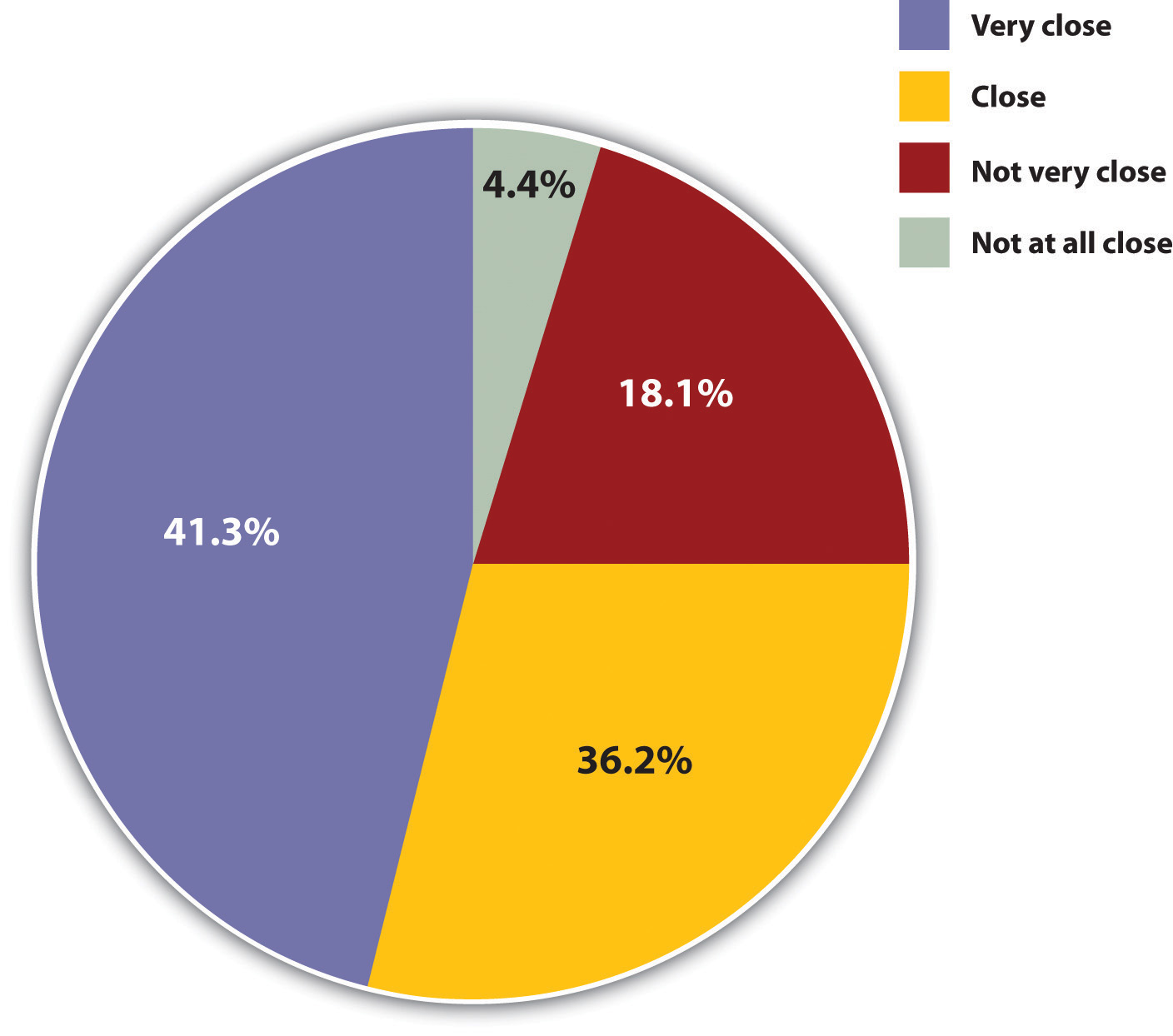
Source: Data from Full general Social Survey, 2004.
A downside of ethnicity and ethnic group membership is the conflict they create among people of different ethnic groups. History and current practice indicate that it is easy to become prejudiced against people with different ethnicities from our own. Much of the residuum of this affiliate looks at the prejudice and bigotry operating today in the The states against people whose ethnicity is not white and European. Around the world today, ethnic disharmonize continues to rear its ugly head. The 1990s and 2000s were filled with "ethnic cleansing" and pitched battles among indigenous groups in Eastern Europe, Africa, and elsewhere. Our indigenous heritages shape us in many ways and fill many of the states with pride, but they also are the source of much conflict, prejudice, and even hatred, equally the detest crime story that began this chapter so sadly reminds us.
Key Takeaways
- Sociologists think race is all-time considered a social construction rather than a biological category.
- "Ethnicity" and "ethnic" avoid the biological connotations of "race" and "racial."
For Your Review
- Listing everyone y'all might know whose ancestry is biracial or multiracial. What do these individuals consider themselves to exist?
- List two or three examples that signal race is a social construction rather than a biological category.
References
Begley, S. (2008, February 29). Race and DNA. Newsweek. Retrieved from http://www.newsweek.com/blogs/lab-notes/2008/02/29/race-and-dna.html.
Berger, P., & Luckmann, T. (1963). The social construction of reality. New York, NY: Doubleday.
Leland, J., & Beals, M. (1997, May v). In living colors: Tiger Forest is the exception that rules. Newsweek 58–lx.
Omi, G., & Winant, H. (1994). Racial formation in the United states of america: From the 1960s to the 1990s (2nd ed.). New York, NY: Routledge.
Painter, Due north. I. (2010). The history of white people. New York, NY: W. W. Norton.
Smedley, A. (1998). "Race" and the construction of human identity. American Anthropologist, 100, 690–702.
Staples, B. (1998, November 13). The shifting meanings of "black" and "white," The New York Times, p. WK14.
Rock, 50., & Lurquin, P. F. (2007). Genes, culture, and human evolution: A synthesis. Malden, MA: Blackwell.
Wright, L. (1993, July 12). One drop of claret. The New Yorker, pp. 46–54.
fritschbassiderae1964.blogspot.com
Source: https://open.lib.umn.edu/sociology/chapter/10-2-the-meaning-of-race-and-ethnicity/
0 Response to "Sociology in the Real World Chapter 2 Review Answers"
Post a Comment