Is the Meg Shark in Th Emovie a Baby or Adult
| Sharks Temporal range: Silurian-present | |
|---|---|
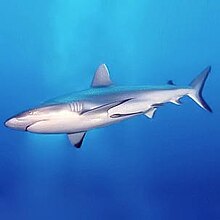 | |
| Grey reef shark (Carcharhinus amblyrhynchos) | |
Scientific classification  | |
| Kingdom: | Animalia |
| Phylum: | Chordata |
| Class: | Chondrichthyes |
| Subclass: | Elasmobranchii |
| Infraclass: | Euselachii |
| Superorder: | Selachimorpha |
| Orders | |
| Carcharhiniformes | |
Sharks are a superorder of fish, the Selachimorpha. They, like other Chondrichthyes, accept skeletons made of cartilage instead of bone. Cartilage is tough, rubbery material which is less rigid than bone. Cartilaginous fish also include skates and rays.
In that location are more than than 350 different kinds of sharks, such every bit the great white and whale sharks. Fossils show that sharks have been effectually for 420 meg years, since the early Silurian.[1]
Nearly sharks are predators: they hunt and consume fish, marine mammals, and other bounding main creatures. However, the largest shark eats krill, similar whales. This is the whale shark, the largest fish in the world. It is widely believed that sharks are "silent killers". All the same, a recent study shows that sharks emit a depression growl from their throats which resonates through their scales.
Some mutual kinds of shark are the hammerhead shark, the great white shark, the tiger shark, and the mako shark. Nigh sharks are cold-blooded simply some, like the great white shark and the mako shark are partially warm-blooded.
Characteristics [change | alter source]
Sharks come up in many unlike shapes and sizes, only most are long and sparse (also called streamlined), with really potent jaws.
Their teeth are constantly replaced throughout their lives. Sharks eat so violently they ofttimes break a few teeth, and so new teeth grow continuously in a groove just inside the mouth and move forward from inside the mouth on "conveyor belts" formed by the skin which they are attached to. In its lifetime, a shark tin lose and regrow as many every bit 30,000 teeth.
Fifty-fifty with all those teeth, though, sharks can not chew. So they bite their casualty and jerk it around so they can pull off a clamper to swallow. The chunks of food that a shark swallows end upward in its stomach, where they are digested. This is pretty slow, notwithstanding, then a meal might take several days to digest. This is why a shark does non eat every solar day.
Sharks take dissimilar-shaped teeth, depending on what they eat. For instance, some sharks take abrupt, pointy teeth, while bottom domicile sharks have cone-shaped teeth for crushing shells. Because there are and then many dissimilar kinds of sharks, and because each kind has its ain kind of special teeth, many people relish collecting shark teeth. Shark teeth collectors can guess how large a shark was past measuring the shark molar. Showtime, they mensurate the length of the tooth in inches. Every inch of tooth equals 10ft of shark length: so if a shark molar is two inches long, the tooth came from a shark that was 20 ft long! Even more terrifying is that some of the Megalodon teeth are 6 inches long then that suggests a shark sixty feet long.
Sharks have pare covered in millions of tiny teeth-similar scales that point to the tail. If yous rub forth a shark towards the tail, information technology feels smooth, but if yous rub the other way, information technology is rough. Sharks' teeth tin abound back if they are lost.
Fins [change | change source]
The fins of sharks are used for stabilizing, steering, lift and pond. Each fin is used in a different manner.
There are ane or two fins present along the dorsal midline called the beginning and second dorsal fin. These fins help the shark from constantly rolling around. These ii fins may, or may not take spines. When spines are present, they are used for defensive purposes, and may besides have peel glands with them that produce an irritating substance.
The pectoral fins are behind the head and extend outwards. These fins are used for steering during swimming and aid to provide the shark with lift.
The pelvic fins are backside the pectoral fins, near the cloaca, and are as well stabilizers.
Not all sharks accept anal fins, only if they do have them, they are found between the pelvic and caudal fins.
The tail region itself consists of the caudal peduncle and the caudal fin. The caudal peduncle sometimes has notches known as "precaudal pits", which are found just ahead of the caudal fin. The peduncle may likewise be horizontally flattened into lateral keels. The caudal fin has both, an upper lobe, and a lower lobe, that can be of different sizes and the shape depends of which species the shark is.
The primary apply of the caudal fin is to provide a "push" while the shark swims. The upper lobe of the caudal fin produces the most amount of the push, and usually forces the shark downwards. The pectoral fins and the shape of the body (like an airfoil) work together to counter this force. The strong, non-lunate caudal fin in most benthic shark species allows the shark to swim close to the seabed (such equally the nurse shark). However, the fastest swimming sharks (such every bit the mako sharks) tend to have lunate-shaped (crescent-shaped) caudal fins. [two]
Senses [alter | change source]
Odour [change | change source]
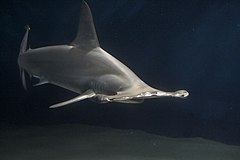
The shape of the hammerhead shark'due south head may enhance olfaction by spacing the nostrils further apart.
Sharks accept swell olfactory sense organs in the short duct between the front and dorsum nasal openings. They can find claret from miles abroad: as little as one part per million of claret in body of water h2o may be enough.[three]
Sharks have the ability to determine the direction of a given scent based on the timing of scent detection in each nostril.[iv] This is like to the method mammals utilize to determine direction of sound.
They are more attracted to the chemicals constitute in the intestines of many species, and every bit a result oftentimes linger well-nigh or in sewage outfalls. Some species, such as nurse sharks, have external barbels that greatly increase their ability to sense prey.
Sight [change | alter source]
Shark eyes are like to the eyes of other vertebrates, including similar lenses, corneas and retinas. Their eyesight is well adapted to the marine environment. They can contract and amplify their pupils, like humans, something no teleost fish can do. A tissue behind the retina reflects low-cal back, thereby increasing sight in darker waters.
Sensing electrical current [alter | change source]
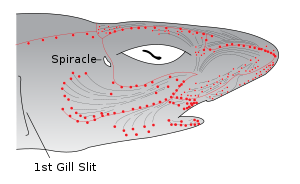
Electromagnetic field receptors (Ampullae of Lorenzini) and move detecting canals in the head of a shark
Sharks take tiny holes all over the shark's snout, specially betwixt the eye and the tip of the snout. In them are nerve receptors which are called the ampullae of Lorenzini. [5] p23 They can sense electricity in the water. Animals in the water give off electricity: every time an animal'southward middle beats or it moves, tiny currents of electricity are made. These tiny electrical currents make signals that travel through water and get sensed. Sharks may apply this sense when they catch their casualty, even more than they use their sight.
Hearing [change | change source]
Although information technology is difficult to examination sharks' hearing, they may have a sharp sense of hearing and tin possibly hear prey many miles abroad.[6] A small opening on each side of their heads (not the spiracle) leads directly into the inner ear through a thin channel.
Lateral line [modify | change source]
The lateral line detects changes in water force per unit area. Information technology is open up to the surroundings by a line of pores. This and the audio-detecting organs are grouped together as the 'acoustico-lateralis system', because they have a common origin. In bony fish and tetrapods the external opening into the inner ear has been lost.
This organisation is found in other fish as well. It detects motion or vibrations in water. The shark tin can sense frequencies in the range of 25 to l Hz.[7]
Prehistoric sharks [change | change source]
Simply a few one thousand thousand years agone, a behemothic shark called Megalodon swam in the seas. It was eighteen meters long, twice as long as the closely-related great white shark, and it ate whales. Megalodon died out 1.vi one thousand thousand years ago.
Much of what nosotros understand about prehistoric sharks comes from the study of their fossils. While sharks have skeletons made of soft cartilage that can fall autonomously before fossilizing, their teeth are harder and easily fossilized. Prehistoric sharks, like their modernistic descendants, would grow and shed many thousands of teeth over their lifetime. For this reason shark teeth are ane of the most mutual fossils.
Reproduction [change | change source]
About 70% of all known shark species requite birth to live immature, with the gestation period lasting from 6 to 22 months.[8]
Pups are born with a total set of teeth, and are capable of taking care of themselves. Once born, they quickly swim away from their mothers, who sometimes feed on the pups. Litters vary from 1 or ii pups (great white shark) to one hundred pups (blue shark and whale shark). [nine]
Some sharks are oviparous, laying their eggs in the water. Shark eggs (sometimes called "mermaid's purses") are covered by a tough, leathery membrane.[9]
Virtually sharks are ovoviviparous, meaning the eggs hatch within the female's body, with the babies developing inside the mother, but there is no placenta to nourish the pups. Instead the young feed on the egg'due south yolk. The pups swallow any unfertilized eggs and sometimes each other. Very few pups in a litter survive until nascency due to this class of sibling cannibalism. Great white sharks, mako sharks, nurse sharks, tiger sharks, and sand tiger sharks give birth this way.[ix]
Some sharks are viviparous, meaning that the females give alive nativity: the eggs hatch within the female person's torso, and the babies are fed past a placenta. The placenta helps transfer nutrients and oxygen from the mother'south bloodstream and transfers waste material products from the baby to the mother for emptying. Examples of viviparous sharks include the balderdash sharks, the whitetip reef sharks, the lemon sharks, the blue sharks, the silvertip sharks, and the hammerhead sharks. Although long thought to be oviparous, whale sharks are viviparous, and pregnant females have been establish containing hundreds of pups.[ix]
New shark discoveries [change | change source]
New sharks are still being constitute. Dave Ebert establish ten new species in a Taiwan market. Over the past three decades he has named 24 new species. They include sharks, rays, sawfish and ghost sharks – these cartilaginous fish are all related.[x]
Angling [change | change source]
Some sharks are not endangered, just some are hunted for nutrient (similar shark fin soup) or sport angling.[11] In 2013 5 species of shark, along with two species of manta ray, received international protection as part of the Convention on International Trade in Endangered Species.[12]
It is thought that 100 million sharks are killed past commercial and recreational line-fishing.[xiii] [xiv] Sharks are a common seafood in many places, including Japan and Australia. In the Australian state of Victoria, shark is the most commonly used fish in fish and chips, in which fillets are battered and deep-fried or crumbed and grilled. In fish and chip shops, shark is called "flake". In India, pocket-size sharks or baby sharks (chosen sora in Tamil and Telugu languages) are sold in local markets. Since the mankind is not matured (not adult), cooking the flesh breaks it into powder. The pulverization is then fried in oil and spices (chosen sora puttu/sora poratu). The soft bones tin can be easily chewed. They are considered a delicacy in coastal Tamil Nadu.
References [modify | change source]
- ↑ This includes the early fossil sharks which are classified under Elasmobranchii. Elasmo-research.org - Biology of sharks and rays
- ↑ "Shark Fins". marinebiodiversity.ca. Archived from the original on 5 December 2013. Retrieved 30 July 2013.
- ↑ Martin, R. Aidan. "Olfactory property and gustatory modality". ReefQuest Centre for Shark Research. Retrieved 2009-08-21 .
- ↑ Jayne M. Gardiner, Jelle Atema 2010. The role of bilateral scent arrival time differences in olfactory orientation of sharks. Current Biology 20 (xiii),<rc-c2d-number> 1187-1191 </rc-c2d-number>[i] Archived 2012-03-08 at the Wayback Motorcar
- ↑ Long J.A. 1995. The rise of fishes: 500 million years of evolution. Johns Hopkins, Baltimore. Chapter 5, p100: Course Placodermi
- ↑ Martin, R. Aidan. "Hearing and vibration detection". Retrieved 2008-06-01 .
- ↑ Popper A.N and Platt C. (1993). "Inner ear and lateral line". The Physiology of Fishes. CRC Press.
- ↑ "Mating and reproduction of sharks". shark.ch . Retrieved 29 July 2013.
- ↑ ix.0 9.i ix.ii 9.3 "Shark reproduction". enchantedlearning.com . Retrieved 29 July 2013.
- ↑ BBC News magazine. [2]
- ↑ "100 meg sharks killed every twelvemonth, report shows on eve of international Ccnference on shark protection". National Geographic. March i, 2013.
- ↑ "Sharks win protection at international merchandise conference. ENS". Archived from the original on 2013-03-13. Retrieved 2013-03-eleven .
- ↑ HowStuffWorks "How many sharks are killed recreationally each year - and why?". Animals.howstuffworks.com. Retrieved on<rc-c2d-number> 2010-09-xvi</rc-c2d-number>.
- ↑ "Shark fin soup alters an ecosystem—CNN.com". CNN. 2008-12-15. Retrieved 2010-05-23 .
Other media [change | change source]
- BBC One: Blue Planet: The adult female who dances with sharks. [three]
- Sharks assault bait ball [4]
fritschbassiderae1964.blogspot.com
Source: https://simple.wikipedia.org/wiki/Shark
0 Response to "Is the Meg Shark in Th Emovie a Baby or Adult"
Post a Comment